Irwin
Courterly
Nov/Dec 1998
Nov/Dec 1998
Volume III Issue 4
- Hobbies (editorial)
- The "Long-cut" Morning Commute Between Hauterive and Pierrabot
- What Hangs on the Hobby Horse
- Robin Report
- Public Transit
- My Hobbies
- Hobbies Suck
- Recipe: Carrot Cake Abbott Style
- Letters to the Editor
Editors
Jennie Abbott
Robin BrooksContributors
Paul-Henri Arnaud
Krista Faries
Janet "Planet" Miller
Submissions
The Irwin Courterly publishes original articles and illustrations. We edit them as appropriate. You retain copyright but grant every Irwin Courterly Productions publication royalty-free permission to reproduce the article or illustration in print or any other medium. Please send submissions at least one month in advance so that the editors can read, edit, and format the submission.
Hobbies
Editorial
The theme of this issue is hobbies. You might be aware of the different takes people have on hobbies: some people don't understand them, some don't have them, and some can't separate their activities from their personal identity. Having discussed hobbies with Planet and Krista over the past month has made me more conscious of hobbies. Janet told me she thinks of sewing as a chore, while Sasha does quilting as a hobby. This makes me wonder: What is the difference between a hobby and a chore? What is the difference between a hobby and a career? Between a hobby and a habit? Between a hobby and an obsession? Between a hobby and life?
I asked around, and got some interesting responses, which you can read about in this issue. My own long, and debatable, list includes: cooking, singing, dancing, Origami, rollerblading, rock climbing, ceramics, going to dance performances and museums, biking around town, knitting, Web pages/HTML, reading, apartment-gardening, making collages, taking public transit, walking, writing letters... and, of course, the Irwin Courterly.
We’d be interested to know what others think about hobbies. What do you do in your spare time? What do you make time to do? Send letters to the editor if you didn’t get a chance to voice your opinion in an article this issue.
The "Long-cut" Morning Commute Between Hauterive and Pierrabot
by Paul-Henri Arnaud
Paul-Henri enjoys mountain biking, and even bikes to work sometimes. For vacation he has been known to go on long bike trips in the mountains of Colorado. He put together the following page, indicating that other, secondary, hobbies of his might be photography and HTML!
NOTE: This page contains numerous graphics and might take some time to load. Readers with slower modems should click with caution. (With a 56.5K speed modem it takes 1-2 minutes to load.)
Click the picture to follow Paul-Henri to work one day.
What Hangs on the Hobby Horseby A. Vokayshun
Since this issue of the IC addresses hobbies, we solicited information on hobbies from IC readers throughout the USA and parts of Western Europe. These poll results include a long list of hobbies--these 20 respondents generally pursue more than one free-time activity. The list ranges from music to mothering, knitting to informal technical support, raising rabbits to reading, (motor)biking to painting. The IC thanks the respondents.
How do you define a hobby? People seem to have their own ideas about what they consider to be hobbies, generally a subjective reading of Merriam-Webster’s definition: "a pursuit outside one’s regular occupation, engaged in especially for relaxation." Etymologically, hobby is short for hobbyhorse, and dates back to 1816. Current connotations include "activities I like doing in my spare time" and regularly practiced pastimes. "Most of all," Vlad wrote, hobbies are "a justifiable means of procrastination."
For most people hobbies are not related to their careers, which confirms the dictionary definition of hobbies as activities outside the scope of "regular occupation." Frank said that computers might have been his hobby, but after all the work he has done for his degree in computer science he no longer wants to waste his spare time on those machines. He would rather take his snowboard out to the fresh snow.
"Since writing is my career I don’t think of it as a hobby," Leta responded. "And since you have to read to be a good writer, I don’t really think of it as a hobby." To the contrary, Winter explained: "Reading is a hobby, people watching is a way of life." Reading was one of the most commonly listed hobbies, but it is also closely related to many kinds of work. In other cases hobbies indirectly relate to careers, such as Clemens’ hope that for his service in the Austrian military he can play in the marching band instead of "crawling through mud and shooting with some stupid guns," or Krista’s activism around public transit and alternate ways of getting to work. For Alba, who "always felt that [she] was a photographer," her hobby and her career were tightly knit without being one and the same: "I was always able to integrate photography into my career. When I was an actress and dancer, I was company photographer. In law school, I photographed everyone for the yearbook, and in college and law school I shot many weddings of my peers [and] I did archival printing...
Others replied "not yet." Tom said so about his piano playing, Dore Mifa and Russ dream of singing/guitar careers, and Jason reported that photography "is becoming more and more related to my career." The good journalist must insist: which came first? The profession or the hobby? Career counselors and self-help job books seem to indicate that making a career out of a hobby is the ideal combination for fulfilling employment. Somewhere in between lies the compromise that may reflect the reality of each person’s calling: "I do consider writing my vocation/profession," wrote Jessye, "but it’s not usually what pays the bills." While some people have jobs to support their favorite hobby, others have extra activities to support their careers.
One thing that differentiates hobbies from chores is whether the activity is optional. Hobbies imply a certain amount of spare time and energy for activities outside of necessary tasks or other responsibilities. They also imply that you’re not getting remuneration for doing them. The problem, of course, is when hobbies become obligations. What might be fun on a small scale becomes a chore to maintain. Most responses to the hobby poll indicate that hobbies are rarely a chore, "if I didn’t love doing it, I wouldn’t do it," or that hobbyists endure the obligatory trials of an activity in order to enjoy the participation. Bands need people to organize events, bunnies need their cages cleaned, gardens need to be weeded and watered, and improvement requires disciplined practice (though we all hope "the pleasure element is still there," as Dore Mifa indicated regarding guitar playing and singing). Part of what changes a hobby to a chore is when it takes longer than originally planned, as Vlad said about his carpentry. "I think it can be both [a hobby and a chore]," Alexis wrote about cooking. "It is one of my favorite hobbies, but I plan these elaborate dinner parties at least once a week and then parts of it become a chore." Luckily, for some people hobbies are "just plain fun."
Intrigued by the issues raised in the opinion piece on Origami, the hobby poll also queried whether the target group obsesses about their side interests. Over two-thirds of the responses refuted that concern, though two answers used the word "passionate" to describe the dedication of the enthusiast. Phil explained that usually he does not obsess, but he went home "after seeing Rostropovich perform with the New Jersey Symphony Orchestra and the New Jersey Performing Arts Center... and practiced for three hours!" Jeana even came right out and said "I’m neurotic about owning my own books and keeping track of them" and "I just became obsessed with swing dancing." Alba "would tear up almost all [her] prints" if they weren't perfect--"Is that obsessive?" she asked, rhetorically.
When people care about a hobby it often fills their thoughts or at least demands a certain amount of attention. Mountain bikers keep their eyes pealed for parts or news of good trails to ride, musicians listen to CDs or attend concerts, parents research educational options, cooks buy groceries, readers browse for books and journals, painters sketch scenes or collect brushes.
Overall, hobbies are a diversion that keep life interesting. For some people cooking is a hobby, for others it is a chore, and for others it is a way of life. Whatever you do for fun, be it watching movies, going for a walk, teasing your cat with a ball of yarn, practicing your swing at the driving range, collecting postcards, or playing Scrabble, that can be your hobby if you want one. When you have some spare time and wonder what to do, what do you select from your own hobby horse?
P.S.
Speaking of owning books, no one in this poll listed collecting things as a hobby. Not stamps, clocks, or even Beenie Babies!Despite Russ listing tennis as one of his almost-daily activities, Susan said "no, I have sports instead. I wish I had some hobbies because now it’s raining."
Robin Report
by Special Correspondent Xip
For this month’s hobby issue, it was not as difficult as it sometimes is to get ahold of the enigmatic Robin S Brooks for an interview. Might this have been due to her open desire to share her hobbies and thoughts on hobbies with the IC readership? This reporter suspects that to have been at least partially true. Indeed, when our crew attempted to initiate a conversation on hobbies, Brooks complained that her opinions had not been solicited in the IC’s hobby survey whose results are analyzed in What Hangs on the Hobby Horse. She angrily referred our editorial board to Polly Tickle, scientist, for tips on developing more efficacious survey methods in the future. "An adequate random sampling can only be legitimately taken from large or extremely homogeneous populations," said Tickle. "To get a clear picture of social forces at work in groups as small as the ICIC (Irwin Courterly Imagined Community), you should really poll your entire readership. Moreover," she warned, "do not put inordinate faith in self-reporting." [The IC staff thanks Dr. Tickle for this useful insight, but contends that our Community is not as small as some might think, having grown by leaps and bounds since the implementation of our Internet edition—eds.]
Since this reporter, too, was in the dark as far as the survey questions were concerned (except, that is, for the question about obsession, which was duly asked of our subject at the end of the interview), Brooks simply extemporized upon the theme of this issue. She suggested that her hobbies are highly variable by season and geographic location, for one thing. In winter, for example, she prefers reading for diversion (she has recently completed Wally Lamb’s She’s Come Undone, Cristina Garcia’s Dreaming in Cuban, and Sergei Dovlatov’s The Compromise), whereas in sunny weather she likes to get outside as much as possible. Sometimes, however, political matters transcend climactic considerations. "Last week," she explained, "I went to the picket lines for something to do. Chanting, singing, and marching in tiny circles in the rain was an excellent way to spend any time I had left after completing my work." And considering that Robin was on strike from her teaching position at UC Berkeley last week, she had plenty of time that was not occupied by paid employment. Picketing was not only a fun social activity and temporary hobby for Robin and the other strikers, but it also turned out to be an effective means of gaining the attention of the university administration, who offered to negotiate with AGSE (the Association of Graduate Student Employees) only 4 days after the strike had begun. The IC will keep our readers up-to-date on UC labor relations in forthcoming issues.
It was still unclear what the subject of our present inquiry does with her mornings — any investigative reporter worth half his salt can see that Brooks has not appeared on the morning news at all recently. [She was, however, on the 10 o’clock news twice during the strike, was featured in an afternoon documentary film produced by the Berkeley journalism school, and she appeared in a late night news item on holiday shopping.—eds.] She admitted to waking up as late as 9:30 on some mornings, and to routinely checking her email immediately upon getting dressed. Pressed for further comment, she finally broke down and confided that she obsesses over one activity—the making of musical compilation tapes, known as "mixes."
In the past year, Brooks estimates that she has produced at least 50 mix tapes. That’s almost one per week! Some are remarkably similar to one another, and some are rejected and erased, but at least 65% are sent to eager listeners all over the world, most notably to Alaska (now to Bellingham, WA, as the former Alaskan has moved back to the Lower 48) and France. Always on the defensive, Brooks asserts that "my hobby is not a violation of copyright or other intellectual property laws, as I only make one copy of the tapes, the mixes are meant exclusively for personal use, and I do not make a profit from my activities." Also, according to Dr. Tickle (op cit.), audio reproductions for educational purposes are partially exempt from the laws in question. Brooks, a teacher by profession (and graduate student by trade), claims that the mixes are important teaching tools, helping individuals far from civilization (i.e. the aforementioned Alaskans, and the French whose very existence is sometimes questioned by the more post-modern members of the ICIC) stay apprised of important cultural developments in the industrialized West.
Asked whether she had any other hobbies that she had not yet divulged, Brooks added rollerblading, conspiracy theories, and small Balkan countries to her list. She emphatically denied bicycling as a hobby, categorizing that activity instead as a mode of transportation, and suggested that cooking, too, was better characterized as part of a "sometimes debilitating (but often delightful) syndrome" than as an avocation. She claims that her only collections are of intangible items, such as personal anecdotes and rhyming couplets, and that she has engineered this intentionally, so as to be better able to afford life on a fixed income after retirement. "This way," she explained, "I will not have to hire anyone to dust these things."
Public Transit
by Krista Faries
I think I acquired my strange obsession with public transit, indirectly, from my Dad. One of my Dad's life philosophies is that cars are ridiculously expensive and a hassle to own and maintain. Cars, he believed, were only for getting places you couldn't get to on your bicycle (like Wisconsin) or for carting around other people who didn't share the same philosophy (like the rest of our family).
My Dad was well-known to my friends as the guy who would ride his bicycle past their bus stop on his way to work, in sub-zero temperatures, through January ice and snow, wrapped in several mismatched layers of hats, scarves, sweaters, and coats, ice clinging to his beard.
As I've gotten older, I've slowly started to appreciate my Dad's philosophy. I've seen more than I wanted of mechanics (honest and dishonest, and all expensive), flat tires, breakdowns, smog checks, insurance, and other drivers, not to mention my cars' own unique personality quirks. Finally, when my last car flaked out on me in the most dramatic fashion (yes, there were flames involved), I decided to try going carless for awhile.
I've flirted with carlessness for years. Often, at the first sign of something wrong with my car, I'd take the bus to work. I should've known something was up when I started hoarding bus schedules in anticipation of my car's next break-down. It wasn't long before I found myself sprawled out on the floor with the AC Transit route maps spread out in front of me, plotting out the places I could go by some combination of bus, BART, and walking, mapping out the most perfect, most efficient route possible.
But it wasn't until recently that I finally admitted it to myself: I'm addicted. I'm fascinated. Public transit is my hobby, or my obsession, depending on how you classify it.
Part of it is just the challenge, the thrill of the sport—trying to get from Point A to Point B without a car, just to prove it can be done.
I see now that it is this same fascination, not just necessity or frugality, that has compelled my Dad to ride his bike to work for the past 30 years. It is the same compulsion that drove him and my brother to bypass the 8-hour car trip to Northern Wisconsin last summer and ride their bikes the whole way.
But there is more to it, as I know there is more to it for my Dad. The thing itself has its own beauty. Every transit system, in every city—each has its own culture. Communities, miniature worlds grow on buses. Neighbors greet each other. People pray. Personalities erupt. People talk out loud to no one in particular. Knowing glances are exchanged.
This community is bound more tightly by its shared secret knowledge. Every bus, every train seems to have its own secret code, its own passwords, for how to pay, how to get on, how to get off. Nothing's entirely transparent to an outsider. It's like joining a secret society—you learn the ropes by surreptitious observation, or by knowing someone on the inside.
My Hobbies
by Ob Session
I have always enjoyed buying attractive postage stamps to use even for bills, because I like things to look pretty, not because I have strong telaphilic tendencies. However, I have recently developed a penchant for collecting pretty stamps from envelopes I receive in the mail. I use them in collage art. What made me worry, though, was that the other day I considered buying the full set of the century stamps and the album the USPS will throw in the bargain for an additional $6.99. Does that mean I would be an official stamp collector, because I'd have a set not intended for their real purpose, and they'll be in a book?
I don't really want to be a collector of stamps. I prefer my more eccentric hobbies, like making paper leaves and grape-bunches to hang along the little, white lights that decorate my living room, or having a custom-made shelf to decorate with my favorite postcards, pretty pictures from calendars (and even postage stamps).
What most concerns me (and my friends and colleagues) is when my hobbies bring out a strange obsession in me. Most recently it happened with making cranes. Last Spring Tai re-taught me how to make Origami cranes, and the more difficult two-piece horse. He gave me some paper to use as I tried new forms, but I got stuck trying to make a giraffe and lost interest. Then when I discovered that Hershey's miniatures come in perfectly square, foil-covered paper wrappers, I made tiny cranes out of them. Tom and his generous cow candy jar supported the mild habit and gradually I accumulated about 25 cranes. A few months later I made a mobile out of them, using chop-sticks and thread. The mobile hangs from the ceiling near my desk at work, and other, larger, origami shapes pose serenely on a box of envelopes nearby.
Recently my friends Ida and Lis announced their wedding date for next July, and mentioned that they would enjoy having 1,000 cranes for it, which folklore says would grant them a wish. I bought some more paper and folded several for them as a down-payment on the 1,000 they hope to acquire, and suddenly felt the urge to make more and more cranes without stopping! I may have calmed down, now, to a reasonable pace with the origami cranes, after having used them in decorating my carved pumpkin for Halloween. So far I have managed not to calculate how many I'd need to make a day in order to have 1,000 by mid-July 1999. It seems like a lot, and I'm going to need some help, because I have so many other hobbies to do!
Hobbies Suck
by Planet
Hobbies can be grouped into four categories: crafts, collections, sports, and self-improvement. Each category is worse than the last.
Even the word "hobby" sounds grandmotherish. It makes me think of the childhood I spent learning, or failing to learn, all the feminine accomplishments society could offer. When I was little, I used to iron my father’s handkerchiefs. Although ironing handkerchiefs only relates tangentially to hobbies, I think it’s revealing that it’s the first hobby-like activity that flashes through my mind. Apparently, my subconscious classifies household chores as proto-hobbies. And who am I to argue?
Don’t get me wrong. I loved ironing my father’s handkerchiefs. I loved the beautiful colors and patterns. I loved the crackling and hissing sounds they made after I sprinkled them with water from the bowl set up on the ironing board. (There was no such thing as a steam iron or even a pump-handled spray bottle in those days.) And it was okay if I scorched them occasionally. Learning to iron, learning to set the table, learning to hang clothes on the line, learning to not blink when your sister put mascara on you, and learning to sew a hem were all part of the same process: learning to be female.
Everything changed in 1970, when I was nine years old. Suddenly the homemaking arts were being invoked as part of a hippie back-to-nature movement. Baking bread, growing sprouts, crocheting, knitting, needlepoint, and making a craft out of any piece of junk somebody threw out became really fashionable. I anxiously attempted to learn to do all of these things. I even collected the pull-tops from soda and beer cans to knit into vests and hats. You can still sometimes find hats made out of those no-longer extant pull-tops in thrift stores. I never quite figured out how to make mine hang together.
I dabbled. I didn’t adequately learn to knit or crochet, and my needlepoint was from kits. The only thing I did well was sewing. I had been sewing since I could remember. I created all of my 1970’s high school fashions, in the tradition of my mother and grandmother, by outsmarting the pattern manufacturers with my re-works and patch-togethers. I always ended up with extra fabric and matching accessories. Especially when I used Vogue patterns. My mother hated Vogue patterns. If I bought one, she would sit down with a cup of coffee and a pencil and mark it up until she had cut the necessary sewing steps in half. Only then would she let me use it.
When I moved away from home, I took my mom’s 1940’s sewing machine with me. My sewing became more imaginative. I bought an old wool army surplus blanket at a thrift store and made a coat that I wore to London. There was a stripe across the blanket that I had to match up at the seams. It turned out beautifully.
I learned to cook from a paperback copy of the just-published Laurel’s Kitchen. I baked fresh bread in the toaster oven of my apartment. I blended tofu spreads. I made vegetable soup. I tried really hard to fit this hippie image of womanhood. And I did fit it for a long time.
But I wasn’t entirely happy. I suffered from the "I can make this at home" syndrome, which doesn’t allow you to enjoy the purchase of any pre-fabricated item. I resented the time I spent creating satin gift bookmarks- time I could have spent reading or studying. I dreaded the inevitable times when things didn’t turn out right. Half-finished patterns. Bread dough I forgot to put salt in. Batches of soup I couldn’t finish and had to throw away.
But most of all, I feared for my future. I had seen my mother’s sewing room fill up with swatches and scraps of unusable fabric. I had thrown out my grandmother’s box of elastic, so old it dissolved into dust if you stretched it. I had listened to my aunt talk about the patterns she bought but never found fabric for. I was afraid of those things happening to me. There is a joke in my family: Each year my aunt and some friends took their kids to the beach for a week. Each year my aunt and her friends dutifully carted along their sewing machines. The first year they invited my mom to join, she brought a blender and made margaritas. My aunt said, "All these years we’ve been bringing the wrong appliance!" The blender permanently replaced the sewing machine.
My mother still makes quilts and bakes bread. But she does this things with a streak of practicality that only a woman who has survived an economic depression, a world war, and five children possesses. She uses a bread machine to make bread, and she sews tiny baby quilts with a state-of-the-art machine. In other words, she doesn’t bother trying to meet some societal-imposed image of perfection. She saw what the 1950’s did to women and she isn’t buying. Martha Stewart’s agenda is anything but hidden to my mom.
I wish I could be like my mother. I wish I could find some middle road. But for me, the scars haven’t yet healed. I still mourn the houseplants I had to abandon when I moved. The fleetingly appreciated home-cooked dinners. The clothes that didn’t turn out anything like the ones in the J.Crew catalog. For me there is no middle road.
Now my stomach tightens when some well-meaning "friend" tells me about a store where I can buy beads and make my own earrings, or somebody asks if I did the painting that hangs in my living room, which was produced by a woman who spent decades studying art. Those things take time, they take practice, and they take talent. They take more energy than I feel like expending. Though there’s an implication of failure in every chance I pass up to create something, I still can’t bring myself to revel in some bead-stringing, oil-painting identity.
Collections are worse. My eldest sister once had a collection of paper napkins. I believe it started when my great aunt gave her four tea napkins with pictures of four different poodles on them. She loved them too much to use them, and that’s how her collection was born. When I was about 10 years old she sensed her window of opportunity and dumped them all on me. I was enthralled. I wanted to grow up to be just like her, and now I had my chance! I collected napkins from every Kentucky Fried Chicken or McDonald’s, every wedding and party, including the potluck dinner where my brother met his future wife, until I had huge boxes of napkins crowding my closet. It was the stupidest collection on earth, and I owned it.
The thing about collections is that once people know you’ve got one, they contribute to it. Relentlessly. Irrationally. And without any real grasp of the subtleties—like when my aunt kept giving my mother images of lions on paper, on pillows, on coasters, when it was ceramic lions my mother collected. People gave me napkins. Napkins autographed by people I’ve never heard of. Cocktail napkins with off-color jokes my mother refused to explain to me. Plain colored napkins like the kind you buy in the picnic section of the grocery store. I had boxes and boxes of napkins.
I was 22 years old when I finally broke free. My nieces were little girls then, and they adored my napkin collection, just as I had adored my sister’s. It was the day one of them told me she was starting her own that I knew the nightmare had to stop. "No!" I yelled. Then I came up with my plan. Whenever they came to my house, I gave them each a napkin, told them the story about it, and forced them to use it, then throw it away. It took five little girls and my own determination an entire summer to exorcise the napkin collection. But we did it, and I’m not even sure they remember the summer of the napkins.
Sports are another headache. I could say that I’m really conflicted about sports, but that doesn’t express my working-class resentment well enough. Nothing symbolizes the vanity of the upper-middle class more than recreational sports. Every single popular sport costs a small fortune in equipment, training, and associated medical bills. I learned that when I was fourteen. That’s how old I was when I found out I was a natural at doing 360s on my cousin’s neighbor’s skateboard. Against my mother’s vehemently expressed wishes, I purchased a $7.00 orange skateboard to ride to school. I adored it.
Until the boy from Hawaii moved next door and set up his skateboard ramps in the driveway. Suddenly I had major competition. He had huge wooden skateboards, really cool friends, and oddly encouraging parents. I was intimidated. I kept up the charade, though, until I skateboarded down a hilly country road and bashed open my elbow and hip miles away from civilization. (Protective padding wasn’t in style yet.) I saw then that I would have to spend every after-school hour practicing on the skateboard ramp, that I would have to pay for ever-more sophisticated skateboard upgrades, and that I would have to be willing to endure a lot of pain before I could skate as breathtakingly as Steve, my next-door neighbor. I gave up. A few weeks ago, while teaching my five-year old goddaughter how to balance on a skateboard twice her size, I felt a pang of lost freedom and regret. But since I now have skiing and cycling to torment me, I stand by my early skateboarding decision.
The worst hobbies are the self-improvement related hobbies. Like teaching yourself a foreign language, or learning to play the guitar. How does one stand oneself during the process? You hate yourself while you’re mangling impossible French verb forms, or learning to bend harmonica notes. It’s a desultory business, unassociated with fun in any way. The French are still going to be rude to you on your two-week vacation, and I’ve never heard anyone at a party play more than the same six pathetic songs that make up their repertoire. It couldn’t possibly be worth it.
Hobbies suck. Reading, watching movies, taking walks, and talking to friends. Those things are worth doing for their own sake. Anything else you should definitely get paid for.
Carrot Cake Abbott Style
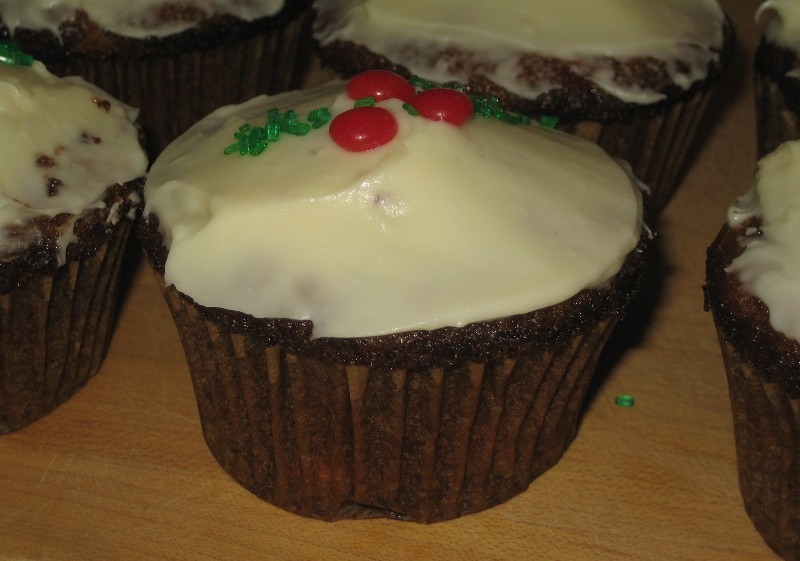
For many years Jennie has enjoyed her favorite carrot cake cupcakes, with cream cheese icing, decorated just so. After grade school she continued to provide these treats to high school classmates, and even in college had them to share! Rarely if ever has Jennie's birthday gone by without carrot cake, and this year is no different (though she now makes her own, following the family tradition of staying up late at night to finish baking them). In case you'd like to make some of your own, the Irwin Courterly provides this recipe, and thanks Abbie for the tradition!Cake ingredients:
- 1 1/3 cup corn oil
- 1 3/4 cup sugar
- 4 eggs
- 2 cup flour
- 2 tsp. baking soda
- 1 tsp. salt
- 3 tsp. cinnamon
- 2 tsp. vanilla
- 3 cup grated carrots (~1 lb.)
Mix oil, sugar, and eggs well.
In a separate bowl sift together flour, baking soda, salt, and cinnamon.
Stir the dry ingredients into the liquid, then add the vanilla and grated carrots.
Pour the batter into cupcake papers (24 total, in muffin tins) and bake at 325 degrees for ~35 minutes (if you make a cake, 2 pans or 9x13" pan, bake for 40-45 minutes). When the cupcakes pass the moist-only knife test, remove and let cool.
Icing ingredients:
- 4 oz. cream cheese (half an average package), softened
- 1/4 cup butter (half an average stick), softened
- 1 tsp. vanilla
- approximately 8 oz. confectioner's sugar (a.k.a. powdered or 10x sugar)
Whip up the cream cheese, butter, and vanilla until mixed and smooth. Sift in sugar a little at a time until it reaches a good spreading consistency and acceptable sweetness.
When the cupcakes are cool, spread the icing on them. Decorate with green colored sugar and red hots in the shape of holly leaves and berries.
Letters to the Editor
Please write to the editor! You don't have to limit your subject to hobbies.