Irwin
Courterly
Summer 2000
Summer 2000
Volume V Issue 3
In this issue:
- Starting to think about children
- Ready for Motherhood?
- On Mothers
- Institutional Mothering
- The Cost of Raising a Child
- Serving children, serving the world
- Commencement speech
- Echoes
- Children of the East
- Readings and poetry, stories, and a lullaby
- Links
We also encourage you to (re)visit the September 1997 education issue, which is also related to the theme of children and society.
Editors
Jennie Abbott
Robin Brooks (in absentia)Contributors
J. Abbie Abbott
Jordan Abbott
Ben Alexandra
Tamara Baltar
Leta Herman
Dobrinka KorchevaSubmissions
The Irwin Courterly publishes original articles and illustrations. We edit them as appropriate. You retain copyright but grant every Irwin Courterly Productions publication royalty-free permission to reproduce the article or illustration in print or any other medium. Please send submissions at least one month in advance so that the editors can read, edit, and format the submission.
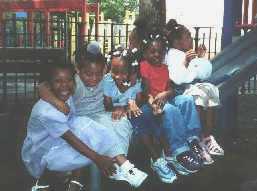
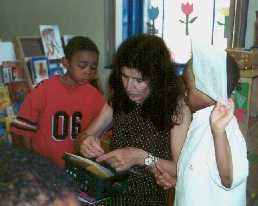
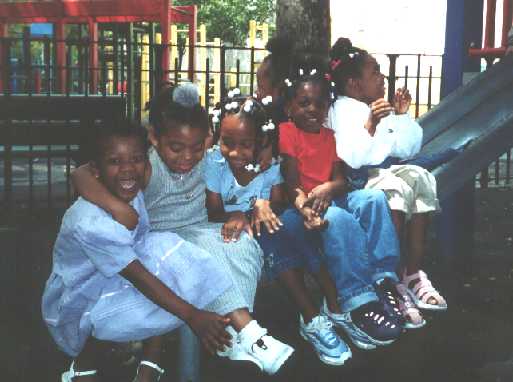
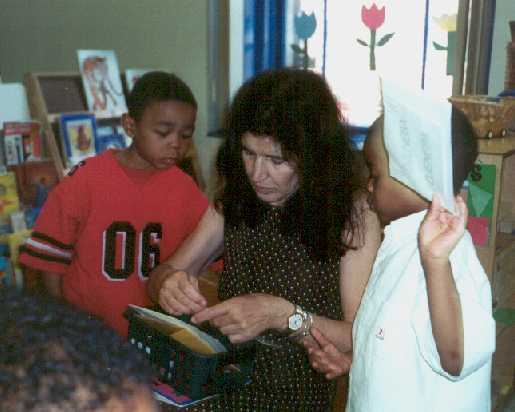
Pre-K on 135th Street (May 2000)
Children are the theme. I decided on this theme of children for the IC after a couple of people asked if I plan to have kids. I'm still not sure of my answer -- I had allowed myself until age 30 to determine and then follow the dictates of my choice. Given my lifestyle, getting pregnant would have to be deliberate, which brings along its own issues of the selection process.
For many years I have wanted to adopt because there are already so many children who need a home -- a place where they are loved and wanted. Related to adoption, and sometimes a precursor, is foster parenting. In some ways, foster care has additional challenges because as a parent you have not legal attachment to the child, and it is hard to give so much to raising children only to feed them back at some point to a problematic system (Administration for Children and Families).
Until recently I vaguely waited for the feeling that I'm not a child myself, too immature to be a parent. Then I observed that sometimes mothers seemed to be ready when the time came, as in the case of a college friend of mine. Or else since she seemed ready and able, I saw myself, her peer, as also capable -- it got me thinking. Now I am ready to plan and consider the details (which abound... Where? When? And how?) in advance preparation for acting on my choice when I am certain of it.
In the meantime, I appreciate the discussions begun below, such as Jordan's, Abbie's, Tamara's commentary. There are so many things to consider before you attempt to raise children in a socially responsible way!
Thinking about children, and about parenting, is an on-going process -- and to that end I hope to continue this issue of the IC over time, adding to it as readers respond and as I progress in my own thoughts. Whether or not you contribute to this theme in this forum, I hope that you will carefully consider children, your own and others', and that you act thoughtfully to help ensure that as a society we may teach and treat them well.
Ready for Motherhood?
by Leta Herman
If you think you'll ever feel ready to have children, you're never going to have them. That's because you'll never be ready, ever. I remember that extreme panic attack I had in my 8th month of pregnancy. I remember saying, &"but I'm still a child, how can I be a mother!" And then I had this awful feeling that I wouldn't be able to be a child anymore, and I cried because I thought I was losing something. The last month of pregnancy is one fraught with fears and grief and yet intense anticipation and excitement.
My friend is 8 months pregnant, and she's in that panic stage right now. It's ironic for me since she is the friend who helped me through my last month, telling me that there's nothing to worry about. Ha! She didn't have any children then--it was easy for her to say.
Now I'm the one consoling her. But this time I'm saying just let whatever happens happen. Just expect it'll only get worse. Like the day you come home from the hospital, and you've got the tiniest little bundle in your arms, and you lie down in bed with it for the first time (because the hospital staff wouldn't let you keep the baby in the narrow hospital beds). And then you realize that what you thought was panic before was a cake walk. Now you're really panicked. You stay up all night watching the baby even though you're so tired you can barely move. But you can't sleep because what if something happens while you're sleeping? And then finally sleep sneaks up on you and takes over in the morning when you weren't expecting it and you wake up and the baby's just fine and you relax a little, just enough, to make it through the day, just enough to learn how to nurse, diaper, burp, and do all the things that no book in the world can teach you.
And suddenly 5 years have passed and now you're ready to have children and your baby's all gown up.
And so you think maybe you should have another and say, "I'm not ready to have another!" And you'll never be if you think that way.
On Mothers
"The well-being of women and children is inseparable."
70 years of field experience has taught us that the quality of children's lives depends on the health, security, and well-being of their mothers. As primary caretakers in virtually every society, a mother's ability to make informed decisions about her children - their health, their education, and their values - will affect them for life. To save children, we must save their mothers.
Charles MacCormack, President
Save the ChildrenJust as we face the endless debate over which comes first with the chicken and egg, we also face the dilemma of where to begin teaching, healing, saving: with the mother? Or with the child who also one day may become the parent? Of course it is not so simple as caring just for mothers at all stages--the other people composing society, parents or not, still need love and education.
Addressing parents and young children together, providing support when needed, approaches the inseparability of women and children that MacCormack mentions.
For more information about mothers around the world, see: State of the World's Mothers 2000
Institutional mothering
by Tamara Baltar
An enormous change took place in American society during the 1980s when the percentage of children under the age of 6 with a parent at home shifted to under 50%. Institutions (daycare, schools, programs) became the surrogate parents for our young.
However, daycare workers and teachers became responsible for far more than feeding, napping, and teaching children to read. Workers outside our homes provide primary parenting to our young children. We place our young in institutions away from our homes for up to 10+ hours per day, 5 days per week, including commute time. Our children receive/take what they need while forming their own self-concepts (during infancy, toddler-hood, and years in care outside elementary school hours) from people we may merely nod hello to as we walk by them during drop-off/pick-up.
Daycare, schools and programs have become our children’s parents experientially and thus are the line connecting us to our young and to their lives as adults. Alongside this was the enormous and totally unacknowledged premise that it was no longer important/guaranteed that mothers (read parent) should be in the home with their young. This was demonstrated by "welfare reform" when assistance to poor single mothers was limited to only a few years rather than being tied to the child having reached a self-sufficient age.
This meant that society was taking away what had already been accepted, and removed vis-a-vis the workforce and social structure by no longer supporting mothers. Instead, capitalism's late 1900s (beginning with the 70s) insisted that women be the new pool of cheap labor in the economy. In accepting this reality (chicken-or-egg: being forced by economic necessity), and not correspondingly adjusting the base premise for these institutions, we have allowed the removal of society from its healthy connection to itself.
Coupled with this, and be careful how you hear me say this, is the fact that, in my opinion, feminism fed right into this when it focused on a woman's right to work as primarily translated into equal salaries, equal jobs, and equal status (read politically correct), and did not recognize the real need of children (and parents) to be together that overrides anything.
How women reconcile their own identities is, of course, as critical as anything. How we understand the needs of our children is shaped by what we are pressured to do and able to do. Our opinions of what children should experience in their first 4-6-10 years is what then makes for the distance we all experience between ourselves and the rest of society as we become adults later.
Institutions did not adjust to the needs of now a majority of our society's young who flow through them and need them to become the parent no longer at home. Daycare workers are now charged with the responsibilities of raising our young. No one really knew this when the conversion was happening. We're still struggling with it. Therefore, when thinking of children, how we come to choose our pathways, resulting in our children's pathways, the way we decide where our children will be raised (in what institutions) becomes critical. That we develop ways to stay in touch with where they are beyond drop-off and pick-up is the challenge. The alternatives become essential. Ways of measuring our health, the health of our children becomes a new and different mechanism and challenge.
We face the sad consequence of having to hold our children at such a distance while they are growing up by not getting to participate intimately in their development. This is seen in a symbolic way by all the incredible gear our society has developed to hold our children at a distance as well -- we now have 45 different types of small vehicles in which to move them (and not hold them). We have many different types of sacks, backpacks, and whatnot in which to again have them at a distance. I am always amazed when I see people carry their infants in those plastic half-moons that have a handle that can be adjusted to sit up the infant -- the whole time, whether while being transported or while at rest, the baby is away from us. Our children have moved a long way away. I not only wonder at this, I know that this is connected to the estranged relationships we have with our young and with our young adults who are now out there.
I have two children, one raised from 8 months old in daycare, and the second one raised until age 6 with me at home full time. Given my political and social beliefs, it took me almost the entire time I was home for the 6 years to adjust to exactly that -- I kept feeling guilty and apologetic the entire time that I could possibly be spending my time being more concerned about what nap time was approaching or that a pot of beans be cooking or that we were about to go to a pottery class for parents and children than I was concerned about my status as a worker/woman in society.
I consider myself lucky that I've had both experiences. It helps me to be able to focus on the questions that need to be asked. A tremendous resource can be found in Arlie Hochschild’s Time Bind (1998), a work which explores the many ways in which institutions shape/define our lifelong interaction within our families.
The Cost of Raising a Child
by Jordan Abbott
A web "clipping" service email I received contained the following: "COST OF RAISING A CHILD - The cost of rearing a child born last year through age 17 will be $160,140 for a middle-income family, up about 2% from 1998, according to figures released by the USDA. For low-income families, those earning less than $36,800, the cost is $117,000, because they spend less on food, housing and other needs."
I laughed scornfully. What do they mean by that? It COSTS less to raise a child if you can’t afford to feed, clothe or house it properly? Yes, you may spend less if you have less, but to word it as they do is an over-simplification, to say the least. The cause-effect logic is off. That’s all some policy makers out there need to see, and the next thing you know we’ll have legislation granting even more privileges to middle- and high-income families because, after all, their children are more expensive. Low-income families don’t need tax credits, or any kind of economic advancement, for that matter—hell, they’re used to cutting corners in order to get by! Keep minimum wage below a living wage, and the parents earning it will be that much more efficient.
It’s true that the children of low-income families are expected by our society to be some kind of a bargain: to grow and learn academically, emotionally, and socially at the same rate with only a fraction of the investment. And then it's made to look like they did something wrong when their unmet needs result in costly challenges to the society that enjoyed the initial savings.
The very end of the quotation alludes to the irony of it’s claim: "…and other needs." The reader only has to pay a moment’s attention to pick up on the indication that if less is spent on "other needs," the needs may remain. I was suspicious about the summary, so referred to the full press release where the emphasis is on the difference in spending rather than the difference in "cost." What troubled me there was the statement "USDA develops annual estimates on the cost of raising a child to assist state agencies and courts in determining child support guidelines and foster care payments." It didn’t indicate which rate—the $160,000 or the $117,000—was used, but I couldn’t help guessing it varied proportionately with the amount spent on an attorney. And it must cost less to represent a low-income person than a middle-income person in court, right?
I didn’t make it all the way to the study itself (http://www.usda.gov/cnpp/using2.htm), but the point is: those looking for an excuse to uphold inequality won't either. Word choice is no small agent in social change—or lack of it. Teach your child this, whatever it costs you.
Serving children, serving the world
by J. Abbie Abbott
Children need us all. They need our life forces, our love. Especially parents, and of course teachers and grandparents, but also neighbors, friends of parents, and parents of friends, as mentors, and even in chance encounters on the street, on the bus, at the shopping mall---we all have opportunities to touch children's lives, however fleetingly.
One of the ways we reach children is through our well-intended interest. We pay attention to them. They need us to have time for them, to make time for them. They need us to believe in them. And they need us to enjoy them. Children need us to lead them into the possibilities of the world by example. "To the child, the parents are playing with him/her, join in his/her reality. To the parents, the child is playing with them, joining them in ever deeper play with the principles of mind." (Joseph Chilton Pearce)
Children learn by doing. They need activities that nourish them, experiences of beauty, of nature, of wonder; of movement, space, peace. The parents of the fortunate child do not restrain body action in favor of some arbitrary "head" activity because they know at this stage the brain is developing through the movement of the body.
Children also learn by imitation. They learn with their whole self, they imitate gesture, intonation, and attitude. We don't want young children to model themselves on computers. If we want them to be full, warm, human beings we must give them the best that we have: warm, human interaction: physical, vocal, spiritual.
Young children are highly suggestible. Jean Piaget called it the stage of concrete operational thinking (concrete: the tangible world; operational: controlled change; thinking still means action for the young child). To young children, parents are omnipotent, their word is truth. If the parent says "You are a joy!", the child is a joy. But if the parent says, "You are stupid," the child will take that as truth and behave stupidly (so as not the disappoint the parent.)
The possibilities of suggestion for good are prodigious, but we draw back and dismiss the potential. Unfortunately, most people are conditioned to surrender personal power and ability to the "professional." Children need to experience us doing our work with gladness and humor, but more and more we give up baking our own bread and buy it from the baker; give up sewing our own clothes, letting prisoners make them for us, and we buy them at the Gap. We do not grow our own food anymore, or even mow our own lawn. And with online services we may not even do our own shopping.
The child whose parent panics and rushes him/her to the professional (that person who stands between self and personal power) undergoes a deep and abiding learning. S/he learns that the parents do not have the personal power s/he believed them to have. S/he learns that the parents cannot act on his/her behalf, that... power and possibility... must be bought from professionals... The parent who panics and shifts responsibility thus dispels the child's own sense of personal power and ability. The child learns that s/he is as impotent as the parents. The stage is set for the child's own surrender of responsibility.
- Joseph Chilton Pearce, Magical Child
Once when my three-year-old daughter had a cough, I took her to see the doctor, who prescribed a medicine. We were then stopping at the pharmacy to get the medicine. Another little three-year-old, who was riding in the car with us, asked where we were going, and when I explained, sagely remarked: "When I have a cough, I cover my mouth." That little girl had a sense of personal power.
Children need us to love and accept the world, and them, as they are, modeling acceptance of what is, working together to make the future better, using difficulties as an opportunity for change. They need us to get to know them, and to give them the opportunity to get to know us. They need us to help them understand that we are all part of something much bigger than we can see, and that we all have our place in it. With competence and confidence we can help one another.
Commencement
by Ben Alexandra, President & CEO, Funky Monk Consulting & Trakkware
Ben is graduating with a Biology major and a Chemistry Minor. Before attending Mesa, he spent 4 years traveling the world, including 3 years in the Far East where he traveled extensively, while studying Chinese. He paid his way by teaching English in Hong Kong, Korea and Taiwan.
While at Mesa, he was involved in numerous clubs and was an active member of the Associated Student Government for three and a half years. He put himself through Mesa by working as a computer consultant and website designer. He recently expanded his company into a software development company specializing in interactive, database-driven websites.
Ben's future plans include expanding his software company and eventually staging a hostile take-over of Microsoft.
--Dr. Gallagher, President of Mesa State College
Too many of us live our lives passively, going day-to-day, without stopping to figure out what makes us happiest. I'm talking about living your passion. This has nothing to do with making money, having a nice house or dating a supermodel. It's about doing what you love, so you never have to actually "work." Take the thing that makes you happiest and turn it into a career. I know you have to pay the bills, but if you live your life to pay the bills, you will die without ever having lived.
I challenge you to name one man or woman who was great and truly "successful," who didn't follow their passion. Beethoven and Einstein were only great because they were fantastic at one thing and they pursued it successfully. They followed their passions. If Beethoven's parents had forced him to be an accountant, I guarantee you I would not be standing here today, talking about "Beethoven: The Greatest Accountant To Ever Live!" because it wasn't his thing.
Take a second, right now, to grab hold of your future and begin to realize it. Close your eyes and imagine yourself ten years down the road. Imagine every aspect of your own life. Your job, your spouse, your kids, your friends. Don't simply imagine the future towards which you are heading, but rather the future which you consider ideal. Forget the expectations which your parents, friends, teachers and relatives have for you, as well as the ones you have for yourself. Ignore, for just a second, all those expectations and concentrate on what you want. Now visualize the road that will take you there. That is your path.
As Dr. Gallagher mentioned, I spent three years traveling in the Far East after high school. I gained a lot of life perspective and learned amazing things about myself and the world. When I returned, the faculty of my high school invited me to speak to the students. I accepted and spoke about how, for a few thousand dollars (a fraction of the cost of college), they could spend a year trekking in Nepal, learning Chinese in Taiwan, bush whacking in Indonesia, meeting new people from dozens of countries and enjoying the intricacies of a colony like Hong Kong. By seeing how other people live and by learning about their customs and religions, you begin to reevaluate your life and learn things about yourself you never knew.
A few days after my talk, I ran into my high school guidance counselor and she told me that students had been coming into her office all week saying that they wish they could do what I had done, but that their parents would never permit it. This was very difficult for me.
Many parents feel strongly about the way their children's lives should be led, and use influence in the form of a car and college tuition to make sure that things go the way they would like to see them go. Now there is no doubt that they do this out of love for their children, but at a certain point they must let go, and let their children live their own lives.
Most of you graduates are at a crucial point in your life. Many of you are now independent, maybe for the first time in your life. As a child, it was your parent's job to instill morals in you and to teach you how to live. They did this by example, and taught you how to live as they lived. As you grew, they saw your potential, and didn't want to see you make the same mistakes that they had made, so they may have maintained some of their control over you. But you are now a college graduate and are free to begin your life.
I graduated from high school as a C+ student. If I had gone straight to college I would have flunked out after the first semester. After traveling, however, I came to college with a tremendous thirst for knowledge that simply didn't exist when I graduated from high school. I applied myself and became a serious pre-med student. My parents, who always thought I would become a doctor, were thrilled. It was all they could talk about for the past few years. Recently, however, I have realized that being a doctor would not make me happy. The long hours, the lack of freedom and concentrating every waking hour on medicine, while giving up hobbies, friends and family became less and less appealing to me. Also, I realized that the thing that got me up in the mornings and made my blood pump faster was technology, not medicine. As the decision not to go to medical school became clearer in my mind, I realized that one of the only reasons I was still considering going, was because it was what my parents wanted me to do. Breaking the news to my parents that I would probably never be a doctor was one of the hardest things I've ever done, but once I did, I felt a huge burden lifted from my shoulders.
I'm asking you to consciously choose your path. If you are sitting here today with a square piece of cardboard on your head, and you realize that the road you are heading down doesn't take you to the future you would like to see, then take the first exit that will take you there. If this means going against the expectations you have had for yourself for as long as you can remember, or even the expectations of people who are close to you, then I hope you have the courage to do that. You deserve a life that will make you happy.
If you are sitting here today with a camera in your hands, a beaming smile on your face and a bag full of film over your shoulder, then I implore you: If your child comes to you for support on his or her decision to take that exit, then please keep in mind that this is their life and they must choose their own destiny. You may think they are making a big mistake, but it is their mistake that they must learn from.
[Pause] "Good luck, fellow graduates, as you cross the line between the safety of college and the brutal reality that is life. Make your life a conscious decision. Don't confuse fun with happiness. And remember that in the real world, 12 hours per week is NOT considered full time."
This speech is posted on Ben's site: http://funkymonk.com/graduation/
Echoes
by Jordan Abbott, 1995
The drive up to Grammy and Grandpa's house in New Hampshire was always a long one. We planned our car-ride entertainment weeks in advance, and looked forward to the surprise toys that would be hidden somewhere in our bags of treasures. We each got the same one, more or less, but the color or some other characteristic was often varied, at least so we could tell them apart. There were other things to load into the light blue Volkswagen bug, most of which fit into the compartment under the hood that looked like it should hold the engine. Daddy's gray suitcase was light and fit in easily. Mommy's red suitcase was heavy and took some maneuvering. The third suitcase was for Jenny and me to share and I never knew quite what was in it until we unpacked it in the cottage. Other paraphernalia was granted spaces inside the car. The green army blanket was neatly folded and tucked under the seat. The red and white Playmate cooler was placed on the "bump" and separated my side of the floor from Jenny's. The tuna fish sandwich lunch was packed in the cooler and preserved for the half-way point of the trip. My bag of cards, cars, animals, wind-up toys, coloring books, and the mystery-waiting-to-be-discovered item was wedged between my feet and gave me a sense of happy anticipation.
Once we turned out of the driveway we were really on vacation, and the space that wasn't packed with luggage or other necessary material things filled up with excitement. A few hours went by before the squabbles started and Mommy had to clarify the line across the middle of the back seat which neither of us could cross without the other's permission. In that time I thought about the two weeks to come. There would be fireflies to watch from the screen porch at night. There would be fire works on the Fourth of July. There would be coleslaw, blueberry muffins, whole milk and maple syrup to enjoy in the main house kitchen. There would be cardinals at the bird feeder. There would be echoes from the half-walled cement chamber build into the side of the hill. I believed they came from the mouths of little elves who heard each word I said and repeated it in playful mimicry. There would be echoes of those vacation for years after Grammy passed away and we stopped making the trek to New Hampshire. I believe they come from the place in my heart where I pack my fondest memories as carefully as we packed the VW bug.
Children of the East
by Dobrinka Korcheva /Sofia, Bulgaria/
To Rita Miller /Warsaw, Poland/Everlasting Marc Twain
When a child gets angry, it usually runs away. A classic example of this in literature is Tom Sawyer. Children in East Europe are no different from Tom, with the exception of the peculiarity that they run away only in their thoughts. Revenge against "bad adults" is not possible for East European children. Indeed, it is not possible for their parents, either. The paradox lies in the fact that whole generations in East Europe have not reached the maturity necessary to be good parents. The population's total infantilism distorts the contacts between parents and their children. Even postmodern gurus of psychoanalysis have given up trying to help people in this geographic region. National psychology in East Europe is not amenable to therapy.
Prisoners of Time
Children of epochs before "perestroika" could find shelter in literature. Children of the present epoch find shelter in the virtual world. They can go wherever they want to when they are angry with everything and everybody. Roles are interchanged - children teach their parents and teachers to walk free across virtual cities of the whole world. This paradox makes us think that something in the history of East and West has been exposed to transmutation and children have surpassed their supervisors. Still, we should not jump to conclusions. There are no remnants of previous false praises of children, in fact there are no remnants of praises whatsoever. Children have turned into prisoners of a generation ever searching for the enemy in the System. The System did not want to build maturity. So our generation's children rejected the System and the conformism it demanded in favor of the possibility to take responsibility for nobody and nothing, to break the chains and resurrect revenge for the child.
Today, from the perspective of another epoch, we might respond that we should not sit back and wait for our children to become our parents and we their children. We are all running in place or in the best case running towards a nonexistent exit. There is nothing to hide. Our natural birth is the result of a pure tradition and inherited patriarchal laws totally mal-adapting and disintegrating the members of the infantile societies of the East.
The Great Game of the Isolants
How can we bask in the sunlight of virtual excursions? The wings of theory are broken in the face of a reality where 73.1% of Eastern European children under 18 years old have not used the Internet and do not use computers. To some extent the Internet in its childish way allows us to run away from the concrete, from the probable and from possibilities understood in their purely human form. Self-absorbed and smothered in the sauce of infantilism, parents of the East make victims of their past, present, and future children, thus facilitating in perpetuity a life without any value for anybody--including themselves. The End of History will come in the South, not the East. This is a real chance for communications--to present us in the different ages and conditions, stimulating the everlasting interest to change and to play. This is much like a time machine and thanks to it we will be able to give birth at one place and time and be born at another. Children of the East know how to shuffle the cards.
Readings and poetry
What is the human being
- Complete security.
Then, a light -- glaring, it pierces:
Cold walls, a cry -- I, the human being, am here.
- A machine of flesh and blood
Living from movement, a sense of time, and feeling.
Wonder at the supernatural,
The pollution of nature, part of the masses.
Part of the group pressure
On the search for the I.
- Live your I and you are free.
Love your world, and you will be carried
By the circulating stream of love,
For love is life.
Cry out your longing, cry hot tears
And you will be free.A poem by Kristina, 16 years old
from Felicitas Vogt
2000 East Coast Waldorf Early Childhood Conference- - - - - - - - - -
A Vignette of "5"
by Ethel Louise Carpenter
from First School Years, a publication of the Jewish Early Childhood AssociationHe was five an in kindergarten. The first time he was told his boots were on the wrong feet he said, "No, these are mind," and the next time, "Well, it doesn't matter. I know where I'm going."
As the weeks went on, we learned that he had a "copper spaniel" dog, he slept in a "four-holster" bed. He had a hole in his boots that "sucked up water," and objected to walking to school on "lumpy" sidewalks. He had a new baby sister who "leaked" and who had a bath when there wasn't any dirt on her.
In school he complained about a child who was acting "too deteriorating" and one day he announced he had had a "mestressing" accident. At the workbench he "ground" good and made Swiss cheese. He didn't like pineapple juice because it "kinda bit" him. He said he loved to eat celery -- he could hear the noise inside his head. He couldn't play with guinea pigs because they were bad for his "energies." He made a very "mykannic" think of wood and wire, and touched dry cell wires to the globe to make the world turn.
He squeezed "shots" of water from a plastic soap container, discovering he could do it to the rhythm of Yankee Doodle. He made a mouse trap and a suit of knight armor. He bottled "milk-week" seeds so he could see them loose without losing them. He raced two words across a board and blew noises out of mailing tubes. He took off his shoes because he liked the rug feeling through his socks. He wore a man-shirt and a necktie which invariably wound up in the workbench vise.
His mock was loaded with pain, his zipper was halfway up, his long belt gathered in too-large corduroy pants. He was a loud-voiced, door-slamming laugher who came to school early so he could get things done before he "got too busy." He wanted to go outside when it rained because "that's when you see the best things."
He moved to another town that summer, and the next year he failed first grade. The school evidently was not ready for him.
- - - - - - - - - -
Kahlil Gibran on children:
Your children are not your children.
They are the sons and the daughters of Life's longing for itself.
They come through you, but they are not from you,
And though they are with you they belong not to you.You may give them your love, but not your thoughts,
For they have their own thoughts.
You may house their bodies but not their souls,
for their souls dwell in the house of tomorrow, which you cannot visit, not even in your dreams.
You may strive to be like them, but seek not to make them like you.
For life goes not backward nor tarries with yesterday.You are the bows from which you children as living arrows are sent forth.
The archer sees the mark upon the path of the infinite, and He bends you with His might that His arrows may go swift and far.
Let you bending in the archer's hand be for gladness;
For even as He loves the arrow the flies, so He loves also the bow that is stable.- - - - - - - - - -
Bedtime can be a challenge -- what child wouldn't feel she is being left out when the grown-ups stay awake, when he has to leave the party? The screaming child being dragged off to the nursery is a miserable one. A bedtime routine can also be a pleasant ritual for all involved. You can read a story, sing a lullaby while in the rocking chair, and tuck the children into bed. Especially if you follow the pattern every night, it will be a functioning, regular, reliable standard that of itself can help soothe them and let them be relaxed and calm enough to fall asleep. Give children your patience and consistent behavior, and they may grow to trust and be patient in return.
Storybooks and lullabies soothe children to sleep as well as educate:
Stone Soup
There was once a soldier returning from the war who stopped to rest in a village along the way. An old woman passing eyed him balefully and said, "We have hardly enough food for ourselves, so don't even ask."
"I am sorry to hear that," replied the soldier, "but perhaps I can help. If you bring a large kettle, I have a special stone with which we can make a most wonderful soup!"
The woman got someone to bring a large kettle, which they half filled with water, and they built a fire under it. The soldier put in his stone and started to stir with a big spoon. Soon steam started to rise from the kettle, and the soldier tasted the soup. "Ah, this is a good soup, but if only we had an onion," said the soldier, "this would be a very tasty soup."
A boy who had come to watch said, "I think my mother has an onion," and he ran and brought it. The soldier thanked the boy, put it in the kettle, stirred the soup, and tasted it again.
"Ah, this is a good soup, but if only we had some turnips," said the soldier, "this would be a very tasty soup."
A little girl who had come to watch said, "I think my mother has some turnips," and she ran and brought them. The soldier thanked the little girl, put the turnips in the kettle , stirred it, and tasted it again.
Each time the soldier tasted the soup he said, "A this is a good soup, but if only we had some carrots, or some potatoes, or some salt, or some barley, or a mutton bone, this would be a very tasty soup." And each time a villager brought something to add to the soup.
Finally, the soldier announced that the soup was fit for a king, and he ladled it out for the villages, who marveled that such a soup could be made from a stone!
Everything Possible
by Fred SmallWe have cleared off the table, the leftovers saved
Washed the dishes and put them away.
I have told you a story and tucked you in tight, at the end of a knock-about day.
As the moon sets its sails to carry you to sleep, over the midnight sea;
I will sing you a song no one sang to me, may it keep you good company.You can be anybody that you want to want to be
You can love whomever you will.
You can travel any country where your hearts leads
And know I will love you still.
You can live by yourself, you can gather friends around,
You can choose one special one
And the only measure of your words and your deeds
Will be the love you leave behind when you're gone.Some girls grow up strong and bold
Some boys are quiet and kind
Some race on ahead, some follow behind,
Some grow in their own space and time.
Some women love women and some men love men
Some raise children and some never do
You can dream all the day never reaching the end
Of everything possible for you.Don't be rattled by names, by taunts or games,
But seek out spirits true
If you give your friends the best part of yourself
They will give the same back to you.You can be anybody that you want to be
You can love whomever you will
You can travel any country where your heart leads
And know I will love you still
You can live by yourself, you can gather friends around
You can choose one special one
And the only measure of your words and your deeds
Will be the love you leave behind when you're gone.
Links
They say that children are the future, but what they hold is the potential for living beyond our own lives. What we teach (by word and deed) they may take with them into the world we present to them.
"Children -- they are the most humbling piece of one's life -- they show you what is important, and stop you in your tracks to appreciate the very littlest of things, and to see what magic we hold with a kiss or a hug -- it warms me so to think of them and their abounding love." - Laurie Earp
The world that children present to us is one that looks different through their eyes. They present us with a fresh perspective on ourselves, society, our environment. The openness with which we listen reflects our own willingness to learn and be challenged.
This is an unending discussion. Please continue to send stories, news, poems, or essays about your childhood, parenting, babysitting, adoption, or Zero Population Growth.