Irwin
Courterly
Most Of 1998
Volume III Issue 3 (April-October)In this issue:
- The Subversion of Westphalia, or That Ferocious Fruit
- Iced Tea
- NutRageous Review
- Restaurant Review
- Leta's New House
- FAB Dance Review
- Love that new Bug: The Allure of German Cars
- Smoky bar culture: Will it last?
- Prayer Voting
- Rats
- Letter to the Editor
Editors
Jennie Abbott
Robin BrooksContributors
Leta Herman
Dave Hoffman
Janet "Planet" Miller
Paul SpinradSubmissions
The Irwin Courterly publishes original articles and illustrations. We edit them to meet our needs. You retain copyright but grant every Irwin Courterly publication royalty-free permission to reproduce the article or illustration in print or any other medium. Please send submissions at least one month in advance so that the editors can read, edit and format the submission.
The Subversion of Westphalia, or That Ferocious Fruitby Mel Anzane
Few people in the world, and certainly few members of the Irwin Courterly Imagined Community (ICIC) would argue with the contention, originally popularized by political economists in the post-Fordist West, that the nation-state is no longer the basic organizational unit in global politics. Some might suggest that the inadequacy of corporatist systems of income redistribution are to blame. Some, like Francis Fukuyama, assert that a Hegelian epistemological dialectic is responsible for ideological convergence, which, in this case, should be viewed as a positive outcome of liberal democracy’s struggle against communist and fascist challenges. Others explain that imperial overstretch, both in terms of geography and in terms of sheer population, is the major causative factor in the decline of once-great powers. Few would guess, however, that a seemingly innocuous fruit is actually the major independent variable contributing to the decline of the organizing principle upon which order in the anarchical world system is based.
In a recent non-directive interview, Polly Tickle (scientist on-call for the IC), responded to questions about this most important issue of Our Times. "Individuals of melancholic spleen," explained Tickle, who has recently been vacationing at an anthroposophic spa, "ought not to consume any plants of the family nightshade." It was not immediately evident to this reporter what our scientific genius meant with her cryptic Shakespearean statement [notice the trochaic pentameter of the second portion of the quotation - eds.], so the IC staff turned to Webster’s 9th New Collegiate, where nightshades are defined as "any of a genus which comprises herbs, shrubs, and trees with alternate leaves, cymose flowers, and fruits that are berries and includes some weeds, various ornamentals, and important crop plants, as the potato and eggplant."
Extensive opinion polling within the ICIC indicated that most of this society has never considered potatoes to be a berry, so investigative reporting for this article has centered around the question of the aubergine. Called "patlajan" in Arabic, Indo-European, and Slavic languages, the eggplant originated in Persia, spread quickly to the Middle East and the Balkans during the Ottoman Empire, and has also achieved prominence in Italian agriculture. Japan produces a smaller version, more convenient for stuffing. [For more on the history of eggplant read this.]
According to one prominent bulk consumer of eggplant and CSU professor who wished to remain anonymous, "the history of eggplant in the U.S. is in fact relatively recent, having begun with Thomas Jefferson’s return from his ambassadorship in France - He brought the seeds and encouraged the cultivation of that lovely creature on this god-forsaken land." Normative judgments about America aside, it seems clear that many people love the "blue tomato," as the eggplant is called on English and German translations of Southern European menus. Indeed, a recent best-selling book on Jackie Kennedy indicates that her all-time favorite food was fried eggplant, slightly breaded. "This, however, to hard-core eggplant lovers is offensive," says our previously quoted anonymous informant, "because the delicate flavor of the eggplant was meant by its original guardians to be enjoyed unadulterated." [So are we in for a clash of civilizations over eggplant issues? - eds.] The artist-formerly-known-as-Prince, unlike Jackie O., sticks to authentic preparations of the beautiful botanical, never insulting the thick violet skin of the fruit with a peeler. He reveres the color of the aubergine to such an extent that purple has become an important part of his identity. In any case, from whence cometh all the eggplant we consume in its various delightful incarnations??? Polly Tickle was less circumlocuitous in her answer to this more direct question.
Apparently, just over sixty percent of eggplants consumed in the United States are imported from abroad. This statistic should lead one to assume that the United States does not have comparative advantage over production of the purple-colored ovoid and therefore relies on trade with other states who can propagate it more cheaply. However, USDA statistics show, somewhat paradoxically perhaps, that eighty percent of the eggplant crop worldwide is grown in New Jersey, U.S.A. Fascinating! Why, in that case, do American consumers not dine on domestic aubergines? The answer to this question, as well as to our original interrogation about the nation-state, contends Tickle, lies in the phenomenon of complex interdependence.
"Realist political theory became obsolete with the emergence of the edible nightshade," Tickle explains. In a world where trade in agricultural produce makes higher standards of living available to citizens of all countries through utilization of the principle of comparative advantage, there is no longer any clear hierarchy of objectives for states who could formerly count on careful attention to military power for their security and sovereignty. One thing is still clear, however: states must avoid entangling themselves into asymmetrical relationships of eggplant dependence. However, without the technological infrastructure to cultivate vegetables and fruits native to more temperate climes, a country like the U.S. must rely on foreign interests to supply it with tasty members of the Solanaceae family ("not to mention bananas," adds Tickle). Fortunately, the United States has comparative advantage in production of other victuals, so that in case of a war that closes down avenues of trade with Japan and Italy, Americans could subsist on cantaloupe from Colorado and cheese from the dells of Wisconsin. But could our soldiers really hold their own in a battle against foreign armies fortified with eggplant? And what about economic power, now that the end of the Cold War has demonstrated everyone’s reluctance to resort to displays of physical force?
The new world order is more about bargaining than conflict. Consequently, America must investigate new possibilities for recovering lost hegemonic ground. While Bob Keohane and Joseph Nye might argue that hegemony is irrelevant now that complex interdependence has resulted in so many cross-cutting asymmetrical interdependencies that no single power will ever become dominant in the world again, Polly Tickle has joined forces with Berkeley Professors Weber and Zysman to point out that the U.S. can use strategic trade to its advantage. Although world demand for eggplant is relatively inelastic, by the mid-1980s there were still untapped markets for the fruit. Tickle hypothesizes that pragmatic American economists recognized that fact, and endowed research into innovative greenhouse technology in New Jersey [itself at that point a rapidly collapsing power - ed.] in order to develop an absolute advantage for the state in production of the coveted comestible. Since innovation can only lead to more innovation, this process began a slippery slope toward American dominance of the foreign eggplant market. By the beginning of this year, our farmers had cornered eighty percent of worldwide trade in the commodity. No more will the Land of the Free be shackled to imperialist farmers, who were previously in a position to influence supposedly sovereign U.S. policy with threats of eggplant embargoes. Moreover, increasing American economic power in this manner has helped to stop the nation-state’s spiral of aubergine-induced decline.
Never fear, then, valiant readers. There is nothing wrong with eating imported eggplant. Doing so should only remind you that you live in a world super power, rich enough to import delicious snacks from overseas, and powerful enough to slow the inevitable flow of history before convergence strips us of our global leadership. Until the next pesky vegetable attempts to thwart our hegemony....
Reference:
Eggplant growing facts: http://www.orst.edu/Dept/NWREC/eggplant.html
Eggplant recipes galore: http://jasper.rad.washington.edu/~manojk/world.html Organic Gardens Bed & Breakfast: http://www.theworks.com/COMM/eggplant/
Iced Teaby Planet
No one understood my feelings about iced tea as well as my boyfriend David. We had grown up in the same town. We had the same childhood feelings about the same childhood places. We examined everything. And we drank iced tea together. He used to critique each restaurant’s blend of leaves ("too minty" was a phrase I learned from him), brewing strength, clarity (cloudy means it’s past its prime), ice content. We both hated lemons dipped in tea. The lemon should be sliced thin and placed on the rim of the glass. We chose restaurants based on whether or not their iced tea met our standards.
I dated David when we were both in our twenties and he lived in L.A. But I had met him earlier, when I was a teenager. His family was the first Jewish family I knew. Little things about his family struck me. Like how, when I had dinner at his house, no one drank milk. Instead they served Hi-C, Hawaiian Punch, or iced tea. I marveled at this. It had never occurred to me that it was possible to serve dinner without milk. Having dinner at David’s house was like entering a world in which the rules of my upbringing didn’t apply.
David died of Crohn’s disease a few years ago. His memorial service was held in the 20th Century Fox studios recording theater. David used to go there to listen to film scores being recorded. He had the largest collection of film music in the world, but he didn’t read music or play any instruments. I used to wonder how he could regard film composers with such unjealous love. He never wished he had their jobs or their lives. He forged comfortable relationships with them—meeting for lunch, phoning each other on weekends—relationships that were based solely on David’s admiration for their work.
There were dozens of composers at David’s memorial service. Even though it had been seven years since I last saw David, I remembered which films each composer had worked on. David had burdened me with that kind of arcane knowledge. As a result, I harbor sentimental feelings about ridiculous movies like Blue Lagoon.
Once David told me a story about a guy who was in love with Isabella Rosselini. He made a movie with her that was produced by 20th Century Fox. After they broke up, he cried whenever he heard the music that announces a 20th Century Fox film. David is my Isabella Rosselini. Before every movie I involuntarily watch for the composer’s name to splash onto the screen. For that split second I miss David.
David’s brother showed home movies at the memorial service. The movies flickered on the screen that the orchestra uses to keep in time with the film. Movies of David as a little boy, before he got sick. Movies from trips to Disneyland and vacations. I thought I could stand it until I saw David, sitting in a restaurant in New York, hold up his glass of iced tea to describe what made it so exquisite.
The following review was written Monday, May 9, 1994 to ViewStar employees by one of their co-workers. The Irwin Courterly thanks Katherine Wenc for sharing this treasure. Happy Hallowe'en!
Review: Reese's NutRageous
by Paul Spinrad, former ViewStar employee
Reese's NutRageous (slot F-10 in the 2nd floor kitchen snack machine; 55˘) can perhaps be best viewed as Reese's answer to M&M / Mars' classic Snickers bar, but it unfortunately lacks Snickers' complexity and seldom-recognized (but oft-appreciated) restraint. Reese's seems to expect the tired device of including whole peanuts to mask over-reliance on mere sweetness and the forgiving adhesive properties of a layer of too-soft caramel. Where Snickers presents an appealing, bittersweet al dente, NutRageous offers sugary mush-- a great disappointment, considering Reese's excellent prior work in the peanut/chocolate genre. I would recommend spending 23% of your Daily Value of Saturated Fat elsewhere.
Restaurant Review
by Tase TinotShen Hua, College Avenue, Berkeley, CA
Just up the street from the two Best of the East Bay Chinese restaurants in the Elmwood district of Berkeley, a new California-Chinese place opened last Spring. Hearing that it was better than the others—"Tom said Jeremy said it makes the other two have to stand up and take notice," Jennie said, [King Yen and Hai Loon King are both reviewed in the IC Travel Guide 1997] Jennie and Robin decided to try it when their movie was canceled.
Walking through the open door and seeing the "marbled" yellow walls and minimalist ornamentation, Robin wondered if it might be owned by Starbucks—a consortium including both caffeine-fix pit stops with artistic decor and health-nut juice bars complete with wheatgrass. While never exactly the same, the interior decoration of those liquid establishments has a distinctive style.
The menu was about average, with several exceptions such as the jelly fish, and some pleasant-sounding variations, such as the Chien Pi orange-peel chicken dish. When the waiter arrived, our faithful critics ordered the potstickers appetizer, vegetarian moo-shu (an old stand-by for them and also a standard for evaluating a Chinese restaurant), and the orange-chicken. While they waited for their food, Jennie and Robin mapped out the elements of the Zodiac signs and sipped ice water.
The potstickers were ok, though Jennie was overwhelmed with the pink pork filling, and when her teeth crunched a bit of ground bone she left the pork outside of the dough (avoiding flashbacks to a day of making sausage on a farm in France a few years ago). Just in time, the moo-shu arrived, with a thick plum sauce on the side. The pancakes were good, the filling fine, perhaps about average. Sadly for Jennie, temporarily averse to meat, the Chien Pi chicken was a plate of small chicken pieces with orange peel and chili peppers for flavor. No vegetables mixed in!
With the completion of their meal (the leftovers made it home to the refrigerator, a compliment) the IC food critics determined that they would have to pan the restaurant in this review. They began by promptly informing Suzanne and Paul-Henri (whom they saw at the corner café) that they prefer the King restaurants to the new spot on the block.
My New House
by Leta Herman, Special to the Irwin Courterly
FAB Dance Reviewby Tutu
I went to see FAB WM (Frank and Bryan Worldwide Movers--San Francisco) in concert a few weeks ago, and sat in the front row. Before the show began the people next to me were discussing writing a review of the performance for some future use, and I thought about writing a review for the Irwin Courterly.
Describing dance, and especially providing some seemingly objective evaluation of a performance, is challenging if not impossible. Appreciating dance, any performance art, or even any art at all, is extremely subjective. Who am I to say that Hilary Bryan and Dawn Frank put on a tremendous show, pulling off their acrobatics with the usual flair and grace? I can describe for you the furrow of Bryan's brow when she shows pain and frustration as part of the act, or the glow of her smile spreading across her face when her body moves in tandem with Frank's and they leap and cavort to live guitar music in their piece Doubt.
I first started describing dance when I was seven, probably. When I listed the classes I took in school to the other girls in ballet class or to other Brownies in my troop, I had to explain what Eurythmy was. Modern dance was a vague concept to me--I didn't know anything about Martha Graham--but somehow it was broad enough to help describe Eurythmy (I must have heard someone else describe it that way first). Now I know more about modern dance, I've seen Pina Bausch, Mark Morris, and Alvin Ailey and it isn't like Eurythmy. Somewhere along the line I learned to describe Eurythmy as an expression of sound, a physical expression of words and music. Surely there is more to it--there are whole schools devoted to the study and practice of Eurythmy, but this is what I know: When you say "P" there is a sound to make with your arms, and when you hear a scale on the piano or the recorder there is a progression the arms make from fully extended out to the sides up to above the head and back down. If there's a sharp note the arms bend.
I took ballet lessons for about ten years, never progressing beyond about the Intermediate level. I took a difficult class, attended it a few times, and found it wonderfully challenging, but it didn't last (I forget why). The teacher was the owner of the studio, and had extremely high expectations. For the first time I was inspired to practice at home because I had to do that or quit. Pretty soon I quit, and then I could play basketball that Winter. Another dance, another expression of emotion, really. Years after that I was at my friend Alex's piano recital in college. She played at the center of the stage, and the music was beautiful (though I forget which pieces she played), but when I ... my eyes could see dancing. I was choreographing my own piece to the sounds that filled the hall. I understood about expressing the music with my body. I forget the steps and patterns I dreamed up that evening, but I'm sure it was a combination of ballet and Eurythmy. One strict discipline was certainly too limiting, but those were the two I knew best.
FAB WM performed with another dancer, Kimiko Guthrie-Kupers, for their piece called Flight. The three of them explored their wings, and all together this piece was the most traditionally "modern dance" for me, the most like other dance I've seen performed in college and since. Having a third person on the stage with them changed the dynamic dramatically, just as having one friend over changes the dynamic of how two sisters play on an afternoon. Two and one always emerges from three, but so do one and one and one. Each doing her own flying, struggling, falling, helping another, and flying together in formation.
In White Wall, and Wall FAB WM conveyed almost palpable tension. Comparing these two pieces is almost like comparing siblings--or maybe good and evil. White Wall featured plastic-coated paper towel costumes (also used as props) as FAB explored the boundaries of a long heap of paper that separated them like a chalk line drawn across a room, as though glass extended up to the ceiling. They struggled with selfishly keeping to themselves, greedily grabbing proffered gifts of their own skirts, and giving until there was nothing left. When the white wall went up (there was a hitch, one of the hooks holding the bar came unclasped from the pulley rope) between them, the audience saw only Frank, with Bryan attacking from behind, until they tore down the wall. When the lights dimmed I was left in the darkness to ponder what deeper meaning I should glean from the demonstration. The program caption reads "Sometimes people get too close." I can read into that, but what would I construe without the program notes?
The use of props, especially plastic, changes the nature of dance in a way. It changed shapes of a body to a plastic object, a shiny and smooth protrusion--it was a foot. It challenges the expectation that people are only people and can't be seen as something else, and might make the audience wonder what we really see. One of the many hugely marked differences between ballet and Eurythmy is the clothing. Ballet is usually performed in tutu and leotard, Eurythmy in natural cotton gowns, flowing with the body, but not displaying its bone structure.
For Wall, the last piece, the audience moved to sit on the floor on the sides of the performance space (it was a black box theater). Once again a wall was between us, with Frank on one side and Bryan on the other. This time the audience was split, and from each angle the show was a little different--many perspectives. This black wall was made of plastic, as if from taped-together industrial garbage bags. When the dancers got caught up in it and squirmed violently I was afraid they were suffocating, it was frightening on a personal level (would I have trusted that they wouldn't die in action if I didn't know them as mortal humans?), but fortunately I never had to rush to administer first aid. I'm not sure if other dance performances have made me catch my breath like that, though.
One last difference for this review, between watching The Nutcracker in Lincoln Center, Alvin Ailey at Zellerbach, and FAB WM at the Fringe Festival: I was in the front row and the dancers were right in front of me, sometimes almost close enough to touch. I saw their ribs rise panting after strenuous bounds, I saw the sweat glisten on their hairlines, I saw that they were people and they were dancing, and even though I never saw her notice me, Hilary said she saw me there, so performing eyes can still see; they're not mechanized mannequins after all.
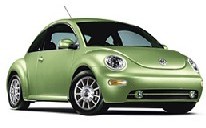
Love that new Bug: The Allure of German Cars
by Bea Tull
Ever since the Irwin Courterlies heard about a VW Golf for sale, they began noticing the abundance of VWs in the area, as well as a marked preference for German cars (most VWs are no longer made in Germany, though. The Rabbit was made in the Us since 1970, and the new Beetles are built in Mexico). The charm of the of the German cars partly comes from a predilection for standard transmissions, also for the compact size and higher status in Liberal circles than American-made automobiles—though perhaps after Japanese cars (no Nazi associations there, or fewer, anyway). [American cars are reputed to require frequent maintenance.]
However, upon test-driving a 1980 Rabbit, Jennie and Robin determined that a really cheap car is not the quality of vehicle they would like to own. To the contrary, Robin’s current rage is for a 1984 BMW 380i they passed on the street one day. For the time being, though, Jennie and Robin continue to get around town by foot, bike, bus, and car rides from generous friends.
Smoky bar culture: Will it last?
by Dya Havalite
California is close to being a smoke-free state. Or is it? As of 1998, smoking is banned in bars, except for the few that have found and acted upon the loop holes in the law. For the majority of San Francisco’s night spots, a new smoking section has appeared: right outside club, bar, and restaurant doors. El Nińo rained on the parade, but the brave smokers kept it up, finding shelter from the weather and dropping cigarette butts in buckets of sand that have started to spring up on urban sidewalks.
Inside, the clientele may have changed to include more non-smokers, though smokers still go, and leave their tables for some "fresh air" and a different conversation outside. As a non-smoker I have often wondered what goes on in the clouded air, between puffs, and over a shared pack of matches. What kind of networking goes on as friends or strangers chat and smoke, become engrossed in a conversation and stay for another cigarette? Maybe the smokers are closing the deals, privy to the same tradition as the "old boy's network" that gathered for scotch (or was it rum?) and cigars after dinner, while the ladies went off to gossip about each other.
Aside from casual smoking interaction outside of public spaces, or in closed-off areas of various establishments, smokers have a different kind of work schedule; sometimes they get much more time off in breaks than non-smokers. I have known people who did work while smoking--one hand holding a butt and one holding a pen; indeed, it makes sense to have meetings outside when all the attendees want to smoke, it's quite practical! Still, I wonder what benefits they reap from having that common bond with other smokers.
Inside at mostly-empty tables, maybe sipping more drinks, are the non-smokers. After they've taken the opportunity to powder their noses without missing out on the conversation, the non-smokers suddenly have their own alternative way of networking. Is their conversation different from that of their compatriots outside? With clearer air and other methods of fidgeting I think the topics must vary.
There are some people who make the most of the awkward situation. "Social smokers" enjoy a healthier lifestyle without missing out on the juicy tidbits murmured with an exhale, and without gaps in time spent with friends. In addition, in warmer climates (or reasonable seasons), non-smokers can keep company with smokers outside in cafés where it's legal--and more polite as the smoker (ostensibly) exhales away from the protected party.Luckily each of these varieties of smoker/non-smokers can share a common bond and have access to the valuable information that mingles with the small talk over bumming a cigarette, offering to buy the next round of drinks, or learning a new step on the dance floor.
In California the Winter rains will resume soon, and smokers may curse the weather and the rules that make them huddle outside in the cold. Just remember, as you cup your hands so the wind doesn't blow out your lighter, that you are participating in a privileged activity, so make the most of it. The rest of us will be inside.
Prayer Voting
by Goyng Tathapols
You may have noticed the lack of separation between church and state when you last went to vote and your polling place was indicated by an American flag in the shadow of a steeple, and your polling both was lit with the colors coming through stained glass windows. It makes sense, sure, that these spaces not filled with religious activity on certain Tuesdays get used for elections rather than closing schools for a day and using the local kindergarten or middle school (and depriving children of another day of school).
When I went to vote for the special election to fill Ron Dellums’ place with our state senator, Barbara Lee, it was the first time I cast my ballot at the polls. All my previous voting had been through the mail as a New Jersey absentee voter.
I got there just a few minutes before the polls closed. I walked to the Shattuck Avenue United Methodist church and entered the door by the flag. It wasn’t the sanctuary or the chapel, but a back room maybe used for coffee hour or fundraisers. I filled out my signature and address, got my ballot, and marked off my choices at the high table. How disappointing that now I’m old enough to vote I don’t get to enter the curtained chamber to punch my card, as I had "helped" my father do when I was little and the polls were at the local fire station. Like some sort of confessional, the gray curtains slid across to give us privacy in that box, full of mysterious levers to push across or punch the ballot with little black buttons next to the appropriate name. Of course it was very important to press the right one, and I touched the buttons lightly and looked up to confirm it with my dad before pushing or switching the lever. (I didn't know what he was voting for.)
At the Shattuck church there was a plastic table with three cardboard sides to protect my secret ballot, and a pencil to make my choice since it was a very short ballot. As I dropped my ballot in the box and got my receipt and an "I voted" sticker, one of the friendly women asked about my family. When I told her that they all live on the East Coast she invited me to her church up on San Pablo in Berkeley. There, she assured me, I could find another family to love and support me alone out here without that extended kinship network. Sister Brooksie wrote down her name and that of her church, and said I could find her there on Sundays, at both services, and when I said I’d take the bus she offered to give me a ride and put down her phone number on the scrap of paper.
I walked home thinking about how religion has pervaded the political, and that the distinction between church and state had blurred. No wonder the Religious Right (Rite) is so successful at controlling politics! Democracy has entered the Christian house of worship. It makes me wonder: How soon before the collection coffers define campaign spending the we drop ballots into baskets of prayer requests?
Put your tithes and your vote together this November 3--money talks and your vote counts.
Rats
by David Hoffman
I don't know if this counts as the single most disturbing thing I've ever seen in my life, but it comes pretty close. Feel free to tell this to your friends, along with the absolute guarantee that it is not an urban myth. This is what I saw last night, with my own eyes, on my way home from dinner, at about 11:00 p.m. on March 17, 1998, in Baku, Azerbaijan:
You guys probably remember the stories of the "rat-land" apartment that Catherine [Dale] and I shared a couple of summers ago in Baku. So far, I've mercifully not been visited by any rats whatsoever. Perhaps my apartment's located in a better area of town, or perhaps it's just the season.
Well, last night, walking along one of the dimly-lit, semi-paved streets in Baku, I saw what looked to be a big mop in the street, or perhaps some kind of bundle of garbage or string or something. It was kind of dark (no streetlights), so it was kinda hard to see. The bundle was moving, but so was everything: the wind was ferocious, and the little garbage-cyclones so typical in Baku were swirling all around.
As I drew closer to the mop, it struck me that it must've been something a bit heavier, since it, unlike the rest of the garbage on the street, was not swirling around or flying in the air. Instead, it could best be described as scurrying about, but in a rather erratic fashion. "A rat," you're thinking, having been tipped-off by the intro to this story. Yes... well, not exactly. Try rats. As in a whole mass of rats -- maybe a dozen and a half or 20 -- with their tails, somehow, tangled and tied together. Somehow, these rats had gotten tangled together, and were frantically scurrying in 10 different directions at once. The "rat-mass" was one ball of rodential fury.
I don't know how the rats got entangled, but apparently they'd been like that for awhile, since quite a few of the rats were either sleeping or dead, and some were definitely dead, since it appeared they were being eaten by some of the other rats. The rat-mass didn't make much noise, but it smelled quite awful, and, once identified, it was truly a horrifying sight to see. I ran away from the mass, even though the majority of the rats chose not to pursue.
Anyway, that's definitely one for the "Let's Go: Azerbaijan" book!
Yer intrepid reporter, D
Letter to the Editor
March 1998
Dear Editor,
I have just completed my first official browsing of the Irwin Courterly web site. I must say, the smorgasbord of articles was a delight in which to partake. But the thing is, I read for a living. At the end of a long month what I really look forward to is something easy on the eyes. So what I am saying is where are the pictures? Where is the art? Is it possible that future issues will have more to look at for those of us who spend all day reading?
Thank you for your consideration.
Seymore Arts